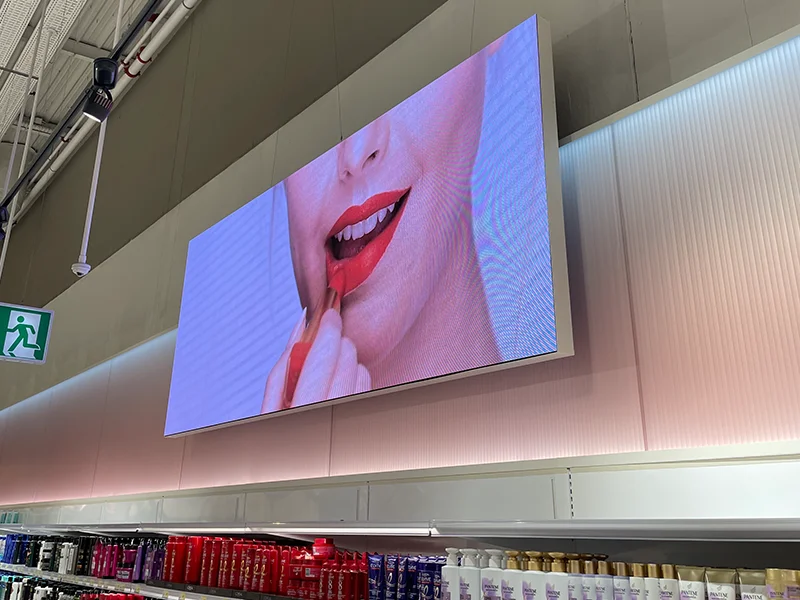
A videowall and an Ledwall can both create large-format images, but they are not the same technology. The choice depends on the space, viewing distance, content and installation conditions—not just the desired image size.
In this guide, we explain how to distinguish between the two solutions, where each can be used and which criteria should be assessed before moving forward with a project.
What is a Videowall?
A videowall is a visual surface made up of multiple displays installed side by side to present content as a single composition. The displays can show a shared image, different content or multiple sources arranged within the same space, depending on the equipment and control system.
The joins between displays create visible lines, known as bezels. The width of these lines varies depending on the equipment. The desired visual continuity and the distance from which the audience will view the image should therefore be considered in the design.
What is an Ledwall?
An Ledwall is a large-format display made up of LED modules. The image is formed by numerous points of light, called pixels, distributed across these modules. The final size can be adjusted by combining modules within the technical capabilities of the chosen system.
The distance between pixels – known as pixel pitch – influences resolution and the appropriate viewing distance: smaller pitches generally allow the image to be viewed more closely with greater definition, while larger pitches may be suitable for longer viewing distances. The choice should take into account the space and content, not just the overall display size.
Ledwall or Videowall: what is the difference?
The main difference lies in how the image is created. A videowall combines individual displays, with joins between them. An Ledwall combines LED modules into a continuous surface, without the bezels typical of a Videowall.
| Aspect | Videowall | Ledwall |
|---|---|---|
How the image is formed | Multiple displays combined into a single composition | LED modules forming a continuous surface |
Visible joins | Present between displays; width varies depending on the equipment | Continuous surface without display bezels |
Size and format | Determined by the number and format of the displays used | Defined by the arrangement of modules, within the system’s capabilities |
Resolution | Fixed, determined by the selected displays | Related to pixel pitch and final size |
Key selection criterion | Bezel width, resolution and lighting conditions in the space | Pixel pitch, viewing distance and installation conditions |
Typical uses | Control rooms, operations centres, meeting rooms and internal communications | Auditoriums, events, reception areas and large-format commercial spaces |
The table provides general guidance. Specific characteristics vary depending on the selected equipment, installation and control system.
Where can a Videowall be used?
Videowalls are used where the aim is to combine multiple image sources or create a large visual surface from individual displays. They can be considered for control and monitoring rooms, operations centres, meeting rooms, auditoriums, exhibition spaces and corporate communication areas.
In control rooms, the layout can make it easier to view different sources simultaneously. In corporate spaces, it can support presentations, meetings or internal communications. The design should take into account viewing distance, lighting conditions, the required resolution and the visibility of the joins.
Where can an Ledwall be used?
An Ledwall may be suitable for large-format installations where image continuity and flexibility in size are important. It can be used in auditoriums, on stages and at events, in commercial spaces, reception areas and visual communication settings.
Outdoor use requires equipment and an installation designed for the site’s environmental conditions. A high-brightness display alone does not mean it is suitable for outdoor use. Equipment specifications, mounting conditions and protection measures need to be assessed.
How to choose between an Ledwall and a Videowall
Viewing distance. The distance between the audience and the display helps determine the appropriate resolution and, for an Ledwall, the pixel pitch to consider.
Size and format. Determine the width, height and aspect ratio of the desired image, as well as the space available for the support structure and maintenance.
Content and sources. Consider whether the system will show a single piece of content, multiple simultaneous sources, presentations, video or dynamic information.
Installation environment. Assess ambient light, indoor or outdoor location, ventilation, temperature and other conditions relevant to the equipment.
Structure and maintenance. Check mounting, technical access, cabling and maintenance requirements. In modular systems, component replacement depends on the equipment and the conditions under which the work is carried out.
Control and operation. Define how content and image sources will be managed, who will use the system and what training or technical support will be needed.
What should the technical design include?
A project should begin with the intended use and the characteristics of the space. From there, the technology type, size and resolution, support structure, electrical power, cabling, ventilation and access required for installation and maintenance can be assessed.
It is also important to plan how content and signal sources will be controlled. The solution should be compatible with the equipment to be connected and with how the team will use the system. A technical site assessment helps identify constraints before installation.
Mistakes to avoid
Choosing solely on the basis of display size can lead to a solution poorly suited to the viewing distance or content. It is also important not to assume that any LED wall can be installed outdoors, or that modularity guarantees replacement without interruption. The conditions depend on the equipment and the planned work.
Another mistake is leaving the structure, cabling and maintenance access until the end. These elements should be considered from the outset, alongside image and operational requirements.
Frequently asked questions
Is an LED wall always better than a video wall? No. Each technology has its own characteristics. The choice depends on viewing distance, size, content, the space and installation conditions.
Does a video wall always have visible bezels? A video wall is made up of individual displays, so there are joins between them. Bezel width depends on the equipment selected.
Does pixel pitch influence viewing distance? Yes. It is one of the factors to consider in the relationship between resolution, display size and the distance from which the audience will view the image.
Can a high-brightness LED wall be used outdoors? Brightness alone is not enough to determine whether equipment is suitable for outdoor use. The specifications and protection provided for the site’s conditions must be confirmed.
Can LED wall modules be replaced individually? This depends on the system, components, access and conditions under which the work is carried out. This possibility should be confirmed for the proposed equipment.
What information should I prepare before requesting a proposal? If possible, provide the dimensions of the available space, viewing distance, type of content, installation location and signal sources to be used. A technical site visit may be needed to verify the conditions.
Conclusion
Ledwalls and Videowalls are distinct solutions for creating large-format visual surfaces. Comparing the technologies based on the space, viewing distance, content and technical requirements helps guide the choice before equipment is specified.
InteliAV designs and installs Ledwall and Videowall solutions for different spaces and uses, according to each project’s requirements. Visit InteliAV’s Ledwall and Videowall page or contact the team to discuss your needs.