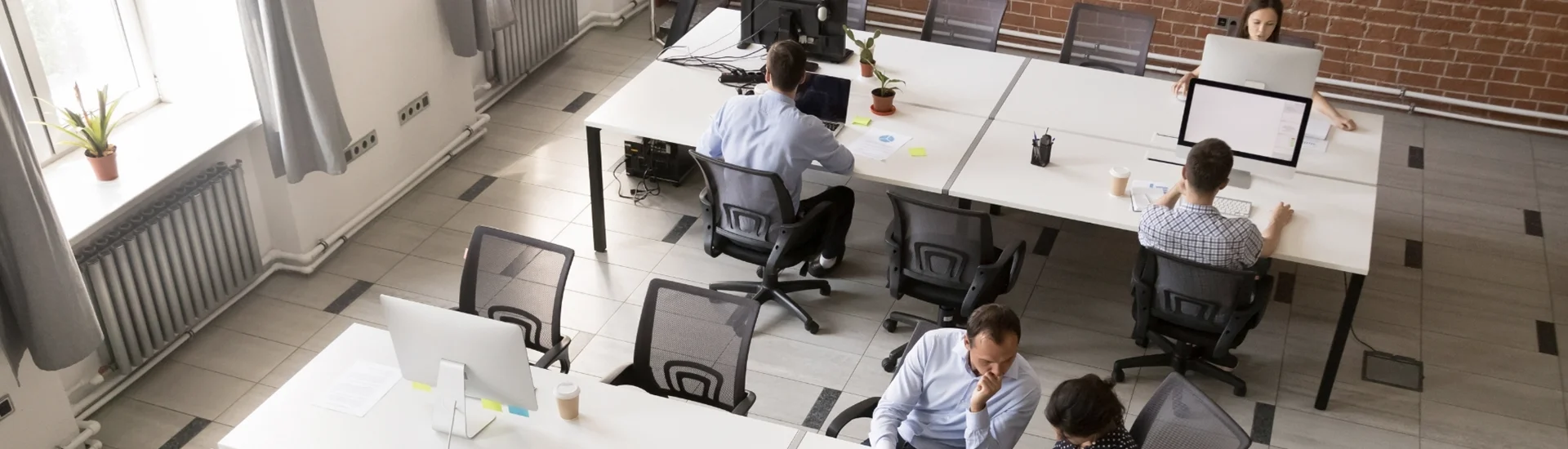
Nearby conversations can be distracting, even when they are not directed at the person working. Sound masking is an acoustic approach that introduces a controlled background sound to reduce the perception of speech at a distance. When planned and adjusted to suit the space, it can contribute to greater speech privacy and a more comfortable working environment.
It does not replace sound insulation, reverberation treatment or good space planning. It is a complementary solution whose suitability depends on the characteristics of the premises and the needs of its users.
What is sound masking?
Sound masking is the controlled playback of a background sound, generally distributed evenly throughout an area, to make distant speech less noticeable. The aim is not to “drown out” conversations or simply increase the volume: the system should be designed to operate discreetly and appropriately for how the space is used.
Masking sound is different from background music. Music is audible, changing content; sound masking aims to create a stable sound environment adjusted to the acoustic purpose defined for the space.
How does it work in an office?
Speech travels through a space and can be understood at a distance, depending on the acoustics, background noise and furniture layout. A sound masking system distributes sound through emitters positioned and configured for the area covered.
The result depends on factors such as ceiling height and type, materials, the geometry of the space, occupancy and the existing sound level. Installation and adjustment should therefore take account of actual conditions on site—not apply a single level indiscriminately throughout the office.
Where might it make sense?
Sound masking can be considered in spaces where speech from nearby areas interferes with concentration, or where the aim is to reduce the perception of conversations outside their immediate area, for example:
-
Open-plan offices;
-
Shared work areas;
-
Reception and service areas;
-
Spaces where the aim is to support speech privacy between areas.
The need should be assessed on a case-by-case basis. In locations with specific confidentiality requirements, sound masking should not be treated as a substitute for appropriate security measures, sound insulation or procedures.
Masking, treatment and insulation: what is the difference?
These approaches address different problems and can, in some projects, be considered together:
-
Sound masking: adds a controlled background sound to reduce the perception of distant speech.
-
Acoustic treatment: changes how sound reflects within a space, for example to control reverberation.
-
Sound insulation: seeks to limit sound transmission between spaces through construction solutions and the elements that separate them.
Identifying the problem correctly is essential. If the main difficulty is echo or reverberation, masking alone may not address the cause. If sound is travelling through walls or doors, the sound insulation will need to be assessed.
How can you assess a solution for your space?
Before specifying equipment, it is useful to analyse the environment and define the project’s objective:
-
Identify the relevant areas: work, circulation, meeting and service areas.
-
Understand how the space is used: number of people, schedules, activities and typical noise level.
-
Assess the acoustic conditions: ceilings, surfaces, partitions, furniture and noise sources.
-
Define the objective: reduce the perception of distant speech, improve comfort or address another clearly identified acoustic need.
-
Plan distribution: emitter locations and zone configuration according to the characteristics of the space.
-
Plan adjustment and validation: verify the result on site and adjust the system according to actual use.
A technical assessment helps determine whether masking is suitable or whether other acoustic measures should be considered.
Design, installation and fine-tuning
The quality of the result depends on the system design, the distribution of emitters and fine-tuning within the space. Installation should take into account the available infrastructure, integration with other systems and access for maintenance.
InteliAV can support the assessment of the space and the definition of a sound masking solution tailored to the project’s needs.
Want to assess the acoustic comfort of your office? Request a proposal from InteliAV.